
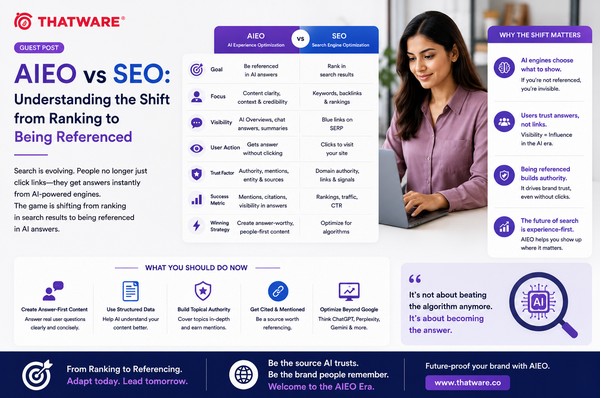
There’s a new acronym making the rounds in search marketing circles: AIEO. Artificial Intelligence Engine Optimization. And like most new acronyms in this industry, it’s provoking a mix of genuine interest, healthy skepticism, and a fair amount of confusion about what it actually means and how it differs from what we already do.
Let’s cut through the noise.
What AIEO Actually Means
AIEO is the discipline of optimizing content and brand presence to be referenced, cited, or surfaced by AI-powered search systems — ChatGPT Search, Perplexity, Google’s AI Overviews, Microsoft Copilot, and the wave of AI assistants that have embedded search capabilities.
The distinction from traditional SEO is real and important. Traditional SEO is about ranking — appearing high in a list of results ordered by relevance and authority. AIEO is about being referenced — being selected as a source when an AI system synthesizes an answer.
Those are related but different goals. And they require somewhat different strategies to achieve.
The Ranking vs. Referencing Gap
Here’s a concrete way to think about it. Say you run a cybersecurity company and you rank #2 for the query “best practices for endpoint security.” Under traditional SEO, that’s a win — you’re getting clicks from people who scroll past the first result.
Under an AIEO framework, the question is different: when someone asks an AI assistant “what are the best practices for endpoint security,” does your content get cited in the response? Does your brand name appear? Are your specific frameworks or methodologies referenced?
You can rank #2 and be completely invisible in AI-generated answers. You can also have a modest organic ranking but be frequently cited by AI systems because your content is authoritative, well-structured, and directly answers the question at hand.
AIEO vs SEO services are increasingly being offered as distinct but complementary packages — traditional optimization for ranked results, layered with AI-specific optimization for referenced visibility. Brands that only invest in one at the expense of the other are leaving significant visibility on the table.
What Makes Content AI-Referenceable
AI systems select sources based on a combination of factors. Perceived authority tops the list — content from brands and authors with strong credibility signals tends to get referenced more. Directness matters a lot — AI systems favor content that answers questions cleanly and specifically, without requiring extensive interpretation. Structural clarity helps — well-organized content with clear headers, definitions, and logical flow is easier for AI to extract meaning from.
There’s also a recency component. AI systems that use retrieval (pulling from the live web rather than purely from training data) favor fresh, current content. Regular publishing cadences and content updates signal to these systems that your site is an active, current source.
AIEO implementation services focus on all of these dimensions: building author authority, restructuring content for extractability, implementing technical schema, and developing the ongoing content strategy needed to maintain AI visibility over time.
The Transition in Practice
For most brands, the transition from pure SEO thinking to AIEO-inclusive thinking is evolutionary, not revolutionary. The foundations are the same: produce excellent content, build genuine authority, and make your site technically sound.
What changes is the lens. You start evaluating content not just for keyword relevance and search volume, but for answer quality and citation potential. You think about your brand as an entity — with a reputation, a body of work, and an area of expertise — not just as a collection of optimized pages.
You measure success differently too. Beyond rankings and organic traffic, you track brand mentions in AI outputs, citation frequency in AI-generated answers, and the quality of your brand’s representation when AI systems describe what you do.
The shift from ranking to being referenced isn’t the end of SEO. It’s SEO growing up — expanding to meet a world where the search experience has fundamentally changed and where visibility means something richer and more complex than a position on a results page.